Search for RSO and most of what you find is written by cannabis retailers about the oil itself. Far less is written about the applicator it usually arrives in, even though the syringe is the part that determines whether a thick extract is easy to store, measure, and dispense. This guide covers what an RSO syringe actually is, how these applicators are constructed, and what to look for if you package or purchase thick oils and concentrates of any kind.
First, What Is RSO?
RSO stands for Rick Simpson Oil, a name commonly used for a thick, dark, full-spectrum cannabis extract. The details of the oil, its uses, and its legal status vary by jurisdiction and are outside the scope of this guide. What matters for our purposes is a physical property: RSO and similar concentrates are extremely viscous. They behave more like cold honey or tar than like a liquid, and that changes what kind of container works.
Droppers cannot pull a fluid that thick. Jars turn dispensing into a scraping exercise and expose the whole batch to air and contamination every time the lid comes off. That is why producers of thick extracts, along with labs and makers who handle heavy adhesives, resins, and gels, standardized on the syringe-style applicator.
What Makes a Syringe an “RSO Syringe”?
There is no formal specification. An RSO syringe is simply a syringe suited to storing and dispensing very thick oil. In practice, that means a few construction features:
- A wide, unobstructed tip or removable cap. Thick oil needs a generous opening to flow at all, especially at room temperature.
- A plunger with a strong, even seal. Viscous fluid creates real back-pressure, so a loose plunger leaks and a sticky one makes controlled dispensing impossible.
- Graduation markings. Users of concentrates typically measure by small increments, so clear volume markings on the barrel matter.
- Chemical-resistant materials. Concentrates are rich in resins and terpenes that can interact with some plastics over time.
Glass vs. Plastic for Thick Oils
Applicator syringes come in plastic and glass, and for concentrated extracts glass has clear advantages. Borosilicate glass is chemically inert, so it does not leach into the product or degrade on contact with strong terpenes and resinous extracts the way some plastics can. It also tolerates temperature changes well. That matters because the standard trick for dispensing a stubborn, cold concentrate is gentle warming, for example running warm water over the barrel. Borosilicate handles that swing without stress. We explain the material fully in our borosilicate glass buyer’s guide.
Glass also reads as premium on a dispensary or retail shelf. For a product that sells at concentrate prices, a cloudy plastic syringe undercuts the brand; a clear glass barrel shows off the oil’s color and clarity.
Understanding the Luer Lock Tip
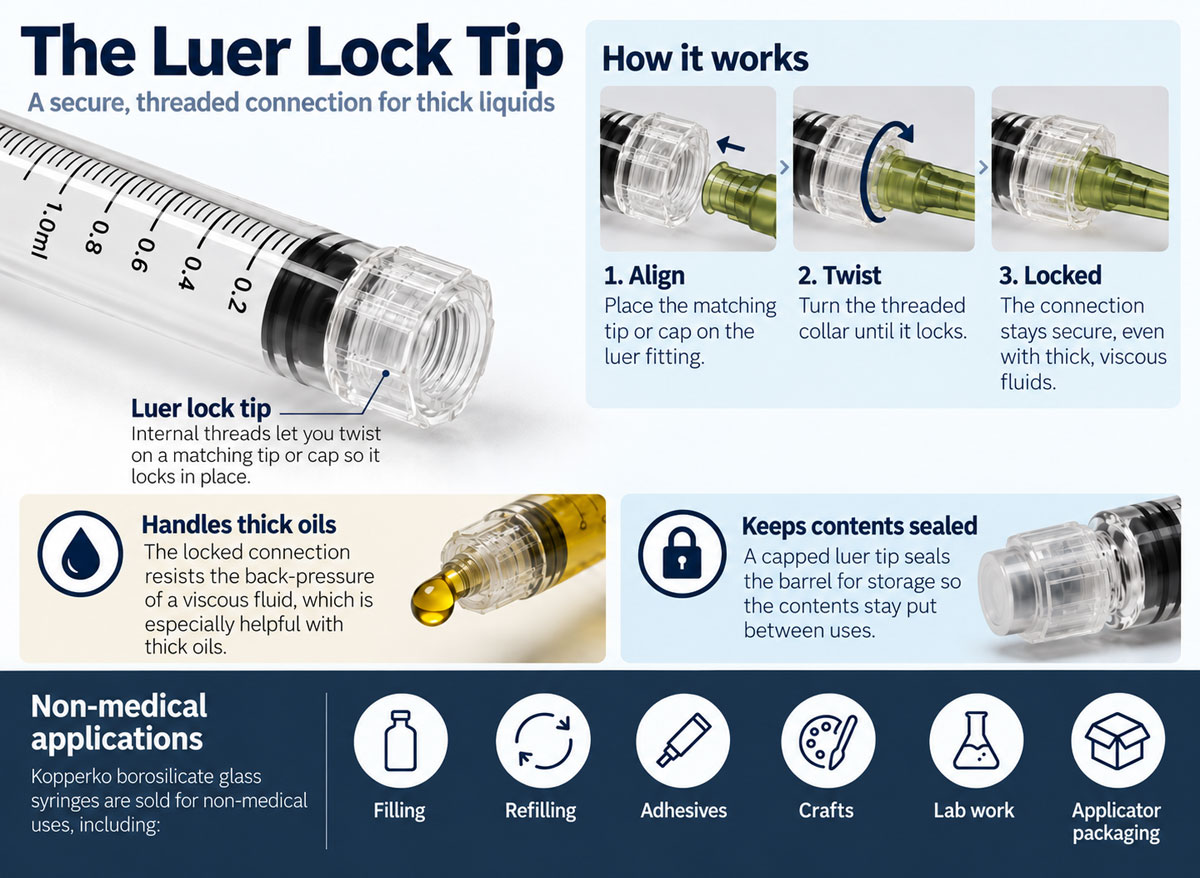
Many glass applicator syringes, including Kopperko borosilicate glass syringes, use a luer lock tip. The Luer fitting is a standardized taper connection: a threaded collar lets you twist on a matching tip or cap so it locks in place rather than pushing on by friction alone.
For thick oils, this is a practical feature, not a medical one. The locked connection resists the back-pressure of a viscous fluid, and a capped luer tip seals the barrel for storage so the contents stay put between uses. Kopperko syringes are sold for non-medical applications such as filling, refilling, adhesives, crafts, lab work, and applicator packaging.
Choosing a Size
Applicator syringes for concentrates are usually small. A 1ml syringe is the common retail unit for extracts, large enough to hold a typical purchase and small enough that graduations stay readable for tiny increments. Producers filling larger containers, or makers using syringes for adhesives and resins, step up from there.
- 1ml: Single-unit retail packaging for concentrates; fine-detail glue and resin work.
- 3ml to 5ml: Bench use, refilling, and multi-dose applicator formats.
- 10ml and up: Transfer and filling work rather than end-customer packaging.
For a fuller walkthrough of volumes and use cases, see our glass syringe sizing guide.
Packaging and Compliance Considerations
If you sell concentrates commercially, the syringe is only half of the package. Most jurisdictions that allow these products require child-resistant secondary packaging, and a pop-top tube is a common option: the syringe rides inside a child-resistant tube that adults can open with a squeeze-and-pop motion while helping meet applicable child-resistance requirements.
Our child-resistant packaging guide covers how that certification works. Always confirm the packaging rules of your own state or province before finalizing a package, since requirements differ by market and product type.
Storing Filled Syringes
A filled applicator syringe is a storage container as much as a dispensing tool, so treat it like one. Cap the tip so the barrel stays sealed and nothing weeps out in a warm pocket or drawer. Store upright where practical, keep filled syringes away from heat and direct light, and keep the graduations facing out so the remaining volume is readable at a glance.
Glass helps here too: an inert borosilicate barrel will not interact with the contents during storage the way some plastics can, and the clear barrel makes the remaining volume easy to see. If you fill syringes commercially, add a batch label to each unit so storage, rotation, and any recall stay traceable.
One habit worth building early is to store filled syringes upright with the tip capped and away from heat and direct light. Thick oils flow differently at different temperatures, and consistent storage keeps handling more predictable from one use to the next.
Care and Reuse
One more advantage of glass is that it can be cleaned and reused for appropriate non-medical applications. A borosilicate syringe used for transfer or bench work can be disassembled, washed, and maintained, while a plastic applicator may cloud, scratch, or hold residue over time.
Our post on how to clean and care for borosilicate glass syringes walks through the routine.
Need a Better Applicator for Thick Oils?
Explore Kopperko borosilicate glass luer lock syringes for thick oils, concentrates, extracts, laboratory applications, adhesives, and specialty packaging. Available in packs from 1 to 1,000 with no bulk minimums.
